
ResearchAssistive living & remote care
Fall Detection
Automatic fall detection from wearable motion, sound and fisheye-camera video, with fewer false alarms.
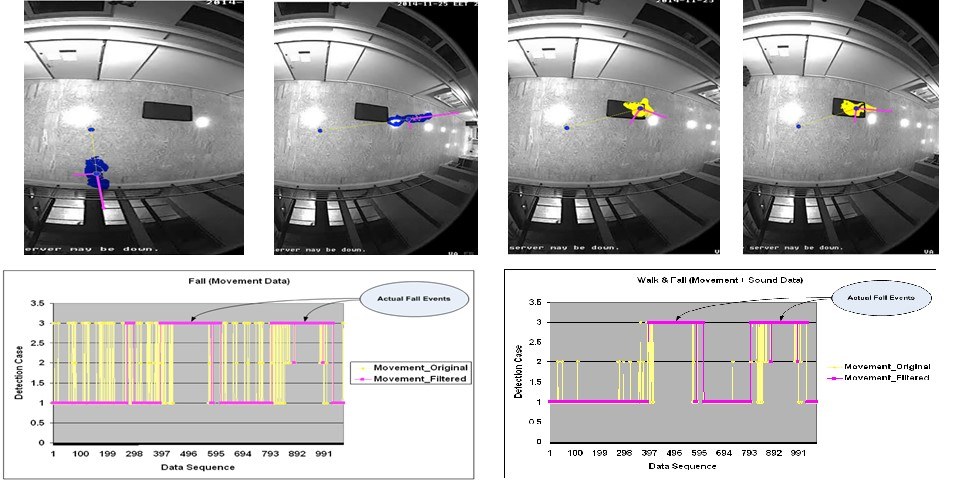
Falls are a leading cause of injury among older adults, and the speed of response matters. We develop systems that detect falls automatically and raise an alarm without requiring the person to press a button.
We combine complementary sources: motion data from wearable and hand-held devices, sound, and video from ceiling-mounted fisheye cameras. Filtering and rule-based evaluation reduce false alarms, while recent work achieves real-time detection with uncalibrated fisheye cameras.
- Wearable and smartphone motion sensing
- Sound and visual data fusion
- Real-time fisheye-camera detection
Related publications
Selected work from the lab in this area.
Hardware/Software Co-Design of a Low-Power IoT Fall Detection Device
In Internet of Things. Technology and Applications. Springer International Publishing, pp. 146–159.
Real-Time Fall Detection Using Uncalibrated Fisheye Cameras
IEEE Transactions on Cognitive and Developmental Systems, 12(3), pp. 588–600.
Deep Learning and Change Detection for Fall Recognition
In Engineering Applications of Neural Networks. Springer International Publishing, pp. 262–273.
Fall detection and activity identification using wearable and hand-held devices
Integrated Computer-Aided Engineering, 23(2), pp. 161–172.
On-Line Fall Detection via Mobile Accelerometer Data
In Artificial Intelligence Applications and Innovations. Springer International Publishing, pp. 103–112.
Fall Detection Using Commodity Smart Watch and Smart Phone
In Progress in Pattern Recognition, Image Analysis, Computer Vision, and Applications. Springer International Publishing, pp. 70–78.
Statistical data mining of streaming motion data for activity and fall recognition in assistive environments
Neurocomputing, 107, pp. 87–96.
Emergency Fall Incidents Detection in Assisted Living Environments Utilizing Motion, Sound, and Visual Perceptual Components
IEEE Transactions on Information Technology in Biomedicine, 15(2), pp. 277–289.
An assistive environment for improving human safety utilizing advanced sound and motion data classification
Universal Access in the Information Society, 10(2), pp. 217–228.
Open Research Issues in Vision-Based Fall Detection Systems (FDS)
In Proceedings of the 7th European Symposium on Biomedical Engineering (ESBME 2010). Greece.
Advanced Classification and Rules-Based Evaluation of Motion, Visual and Biosignal Data for Patient Fall Incident Detection
International Journal on Artificial Intelligence Tools, 19(02), pp. 175–191.
Statistical data mining of streaming motion data for fall detection in assistive environments
In 2011 Annual International Conference of the IEEE Engineering in Medicine and Biology Society. IEEE, pp. 3720–3723.