
ResearchActivity recognition & augmented reality
Activity Recognition
Recognising human activity and posture from a single ceiling-mounted fisheye camera.
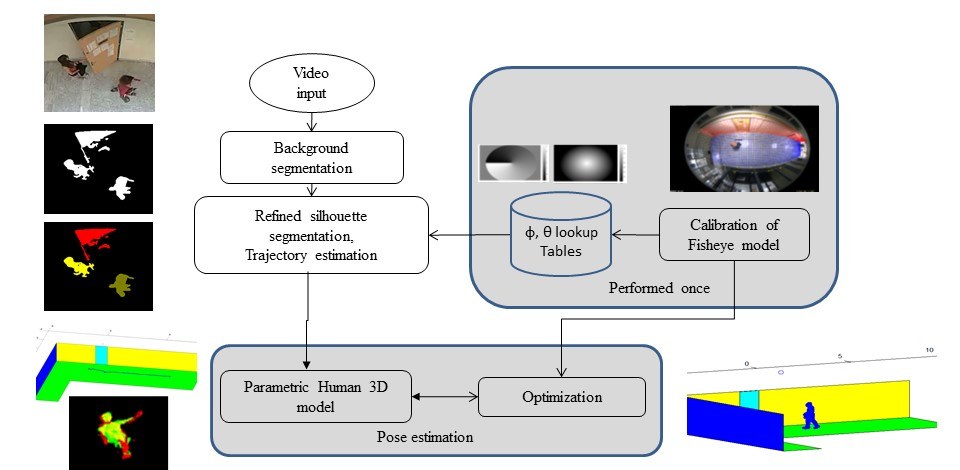
Understanding what a person is doing at home — walking, sitting or lying down — is the basis of many assistive services. We recognise human activity and posture from a single ceiling-mounted fisheye camera that covers a whole room.
The pipeline separates the person from the background, refines the silhouette and estimates their trajectory, then fits a parametric 3D human model using a calibrated fisheye camera model. We have also used Zernike descriptors and convolutional neural networks for pose recognition directly on omni-directional images.
- Silhouette segmentation in omni-directional video
- Fisheye camera calibration
- 3D pose estimation and recognition
Related publications
Selected work from the lab in this area.
Spatio-Temporal Analysis of Handball Players
Actions from Broadcast Videos Using Deep Learning’, Big Data and Cognitive Computing, 10(4), p. 118.
Setting a Baseline for Long-Shot Real-Time Player and Ball Detection in Soccer Videos
In 2023 14th International Conference on Information, Intelligence, Systems & Applications (IISA). IEEE, pp. 1–7.
Automated Posture Analysis for the Assessment of Sports Exercises
In Proceedings of the 12th Hellenic Conference on Artificial Intelligence. ACM, pp. 1–9.
Amateur football analytics using computer vision
Neural Computing and Applications, 34(22), pp. 19639–19654.
Feature Extraction and Pattern Recognition from Fisheye Images in the Spatial Domain
In Proceedings of the 13th International Joint Conference on Computer Vision, Imaging and Computer Graphics Theory and Applications. SCITEPRESS – Science and Technology Publications, pp. 460–465.
Pose recognition using convolutional neural networks on omni-directional images
Neurocomputing, 280, pp. 23–31.
Silhouette labeling and tracking in calibrated omnidirectional video sequences
In Proceedings of the 9th ACM International Conference on PErvasive Technologies Related to Assistive Environments. ACM, pp. 1–7.
Convolutional Neural Networks for Pose Recognition in Binary Omni-directional Images
In Artificial Intelligence Applications and Innovations. Springer International Publishing, pp. 106–116.
Video Analytics for Activity Recognition in Indoor Environments Using Fisheye Cameras
In XIV Mediterranean Conference on Medical and Biological Engineering and Computing 2016. Springer International Publishing, pp. 1105–1110.
Geodesically-corrected Zernike descriptors for pose recognition in omni-directional images
Integrated Computer-Aided Engineering, 23(2), pp. 185–199.
A novel robust approach for handling illumination changes in video segmentation
Engineering Applications of Artificial Intelligence, 49, pp. 43–60.
Joint segmentation and classification of actions using a conditional random field
In Proceedings of the 8th ACM International Conference on PErvasive Technologies Related to Assistive Environments. ACM, pp. 1–4.
A novel hybrid approach for human silhouette segmentation
In Proceedings of the 8th ACM International Conference on PErvasive Technologies Related to Assistive Environments. ACM, pp. 1–4.
Multicamera fusion for online analysis of structured processes
In Proceedings of the 7th International Conference on PErvasive Technologies Related to Assistive Environments. ACM, pp. 1–7.
Fish-Eye Camera Video Processing and Trajectory Estimation Using 3D Human Models
In Progress in Pattern Recognition, Image Analysis, Computer Vision, and Applications. Springer International Publishing, pp. 385–394.
Calculation of Complex Zernike Moments with Geodesic Correction for Pose Recognition in Omni-directional Images
In Progress in Pattern Recognition, Image Analysis, Computer Vision, and Applications. Springer International Publishing, pp. 375–384.
Activity Recognition in Assistive Environments: The STHENOS Approach
In Universal Access in Human-Computer Interaction. Aging and Assistive Environments. Springer International Publishing, pp. 525–536.
Pose Recognition in Indoor Environments using a Fisheye Camera and a Parametric Human Model
In Proceedings of the 9th International Conference on Computer Vision Theory and Applications. SCITEPRESS – Science and Technology Publications, pp. 470–477.
Refinement of human silhouette segmentation in omni-directional indoor videos
Computer Vision and Image Understanding, 128, pp. 65–83.
Human segmentation and pose recognition in fish-eye video for assistive environments
In 13th IEEE International Conference on BioInformatics and BioEngineering. IEEE, pp. 1–5.
Real Time Indoor Robot Localization Using a Stationary Fisheye Camera
In Artificial Intelligence Applications and Innovations. Springer Berlin Heidelberg, pp. 245–254.
Fusion of Color and Depth Video for Human Behavior Recognition in an Assistive Environment
In Distributed, Ambient, and Pervasive Interactions. Springer Berlin Heidelberg, pp. 42–51.
Video Segmentation of Moving Humans for Assistive Environments
In Informatics, Management and Technology in Healthcare. IOS Press.
Fisheye camera modeling for human segmentation refinement in indoor videos
In Proceedings of the 6th International Conference on PErvasive Technologies Related to Assistive Environments. ACM, pp. 1–8.
Near real-time human silhouette and movement detection in indoor environments using fixed cameras
In Proceedings of the 5th International Conference on PErvasive Technologies Related to Assistive Environments. ACM, pp. 1–7.
Video-surveillance and context aware system for activity recognition
In Proceedings of the 3rd International Conference on PErvasive Technologies Related to Assistive Environments. ACM, pp. 1–2.
Intelligent Sampling Consensus for Homography Estimation in Football Videos Using Featureless Unpaired Points
IEEE Access, 13, pp. 187843–187857.
Using synthetic camera poses for camera calibration in soccer videos
Multimedia Tools and Applications, 84(18), pp. 18967–18991.
CNN-Based Visible Light Positioning via Passive Wall-Distributed Optical Sensors
In Artificial Intelligence Applications and Innovations. Springer Nature Switzerland, pp. 378–391.