
ResearchMedical imaging & computer vision
Digital Dermoscopy Image Analysis
Computer vision that turns dermoscopy images into objective measurements for the early detection of melanoma.
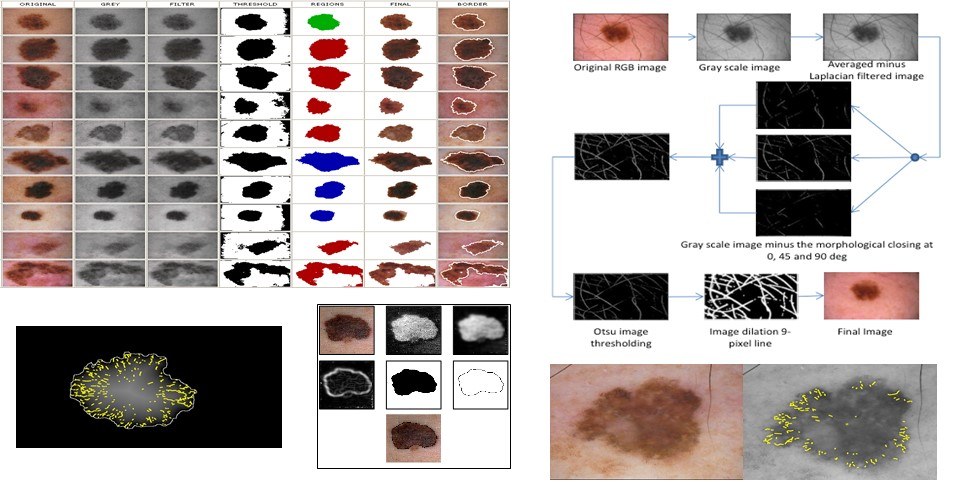
Dermoscopy magnifies pigmented skin lesions and reveals structures that are invisible to the naked eye. We develop computer vision pipelines that turn these images into objective, reproducible measurements to support the early detection of melanoma.
Our work covers the full processing chain: hair and artefact removal, lesion segmentation and border detection, extraction of colour, texture and structural features such as globules and dots, and classification with classical machine learning and deep neural networks.
- Hair and artefact removal
- Lesion segmentation and border analysis
- Feature-based and deep-learning classification
Related publications
Selected work from the lab in this area.
Skin image analysis for detection and quantitative assessment of dermatitis, vitiligo and alopecia areata lesions: a systematic literature review
BMC Medical Informatics and Decision Making, 25(1).
Vitiligo Skin Segmentation: An Image-Based Unsupervised Learning Approach
In Proceedings of 2024 International Conference on Medical Imaging and Computer-Aided Diagnosis (MICAD 2024). Springer Nature Singapore, pp. 246–255.
Automated hair removal in dermoscopy images using shallow and deep learning neural architectures
Computer Methods and Programs in Biomedicine Update, 4, p. 100109.
On the Reusability of ISIC Data for Training DL Classifiers Applied on Clinical Skin Images
In Artificial Intelligence Applications and Innovations. AIAI 2022 IFIP WG 12.5 International Workshops. Springer International Publishing, pp. 199–212.
Ensembles of Deep Convolutional Neural Networks for Detecting Melanoma in Dermoscopy Images
In Computational Collective Intelligence. Springer International Publishing, pp. 523–535.
Fully Connected Visual Words for the Classification of Skin Cancer Confocal Images
In Proceedings of the 15th International Joint Conference on Computer Vision, Imaging and Computer Graphics Theory and Applications. SCITEPRESS – Science and Technology Publications, pp. 853–858.
Explainable Fully Connected Visual Words for the Classification of Skin Cancer Confocal Images
In 11th Hellenic Conference on Artificial Intelligence. ACM, pp. 67–73.
A Review on State-of-the-Art Computer-Based Approaches for the Early Recognition of Malignant Melanoma
In Advanced Computational Intelligence in Healthcare-7. Springer Berlin Heidelberg, pp. 81–101.
Improving the performance of convolutional neural network for skin image classification using the response of image analysis filters
Neural Computing and Applications, 31(6), pp. 1805–1822.
Detection of Malignant Melanomas in Dermoscopic Images Using Convolutional Neural Network with Transfer Learning
In Engineering Applications of Neural Networks. Springer International Publishing, pp. 404–414.
Hair removal on dermoscopy images
In 2015 37th Annual International Conference of the IEEE Engineering in Medicine and Biology Society (EMBC). IEEE, pp. 2960–2963.
Automated Detection of Streaks in Dermoscopy Images
In Artificial Intelligence Applications and Innovations. Springer International Publishing, pp. 45–60.
Skin Lesions Image Analysis Utilizing Smartphones and Cloud Platforms
In Mobile Health Technologies. Springer New York, pp. 435–458.
Enhancing classification accuracy utilizing globules and dots features in digital dermoscopy
Computer Methods and Programs in Biomedicine, 118(2), pp. 124–133.
Automated skin lesion assessment using mobile technologies and cloud platforms
In 2012 Annual International Conference of the IEEE Engineering in Medicine and Biology Society. IEEE, pp. 2444–2447.
Independent Component Clustering for Skin Lesions Characterization
In Artificial Intelligence Applications and Innovations. Springer Berlin Heidelberg, pp. 472–482.
A medical ontology for intelligent web-based skin lesions image retrieval
Health Informatics Journal, 17(2), pp. 140–157.
Skin lesion diagnosis from images using novel ensemble classification techniques
In Proceedings of the 10th IEEE International Conference on Information Technology and Applications in Biomedicine. IEEE, pp. 1–5.
Classification of dermatological images using advanced clustering techniques
In 2010 Annual International Conference of the IEEE Engineering in Medicine and Biology. IEEE, pp. 6721–6724.
Skin Lesions Characterisation Utilising Clustering Algorithms
In Artificial Intelligence: Theories, Models and Applications. Springer Berlin Heidelberg, pp. 243–253.
Overview of Advanced Computer Vision Systems for Skin Lesions Characterization
IEEE Transactions on Information Technology in Biomedicine, 13(5), pp. 721–733.
Reviewing State of the Art AI Systems for Skin Cancer Diagnosis
In Maglogiannis, I., Karpouzis, K., Wallace, M. and Soldatos, J. (eds) Emerging Artificial Intelligence Applications in Computer Engineering: Real Word AI Systems with Applications in eHealth, HCI, Information Retrieval and Pervasive Technologies. Frontiers in Artificial Intelligence and Applications, 160. Amsterdam: IOS Press.
Skin Lesion Recognition with Region Growing Methods
In Zharkova, V.V. and Jain, L.C. (eds) Intelligent Paradigms of Feature Recognition in Astrophysical and Medical Images. Berlin: Springer, pp. 123–149.
Detection of Irregular Edges in Skin Lesions Using Parametric Active Contours for Dermatological Digital Images
Journal on Information Technology in Healthcare, 5(2), pp. 97–104.
Computational vision systems for the detection of malignant melanoma
Oncology Reports.
An Integrated Computer Supported Acquisition, Handling, and Characterization System for Pigmented Skin Lesions in Dermatological Images
IEEE Transactions on Information Technology in Biomedicine, 9(1), pp. 86–98.
Design and Implementation of a Calibrated Store and Forward Imaging System for Teledermatology
Journal of Medical Systems, 28(5), pp. 455–467.
Automated Segmentation and Registration of Dermatological Images
Journal of Mathematical Modelling and Algorithms, 2(3), pp. 277–294.
A system for the acquisition of reproducible digital skin lesions images
Technology and Health Care, 11(6), pp. 425–441.
An Inspectable Vision-Language and Convolutional Ensemble for Facial Pigmented Lesion Diagnosis
In Innovating Bioengineering Through Next-Generation Computational Approaches. Springer Nature Switzerland, pp. 295–312.
Zero-Shot Segmentation of Skin Conditions: Erythema with Edit-Friendly Inversion
In Proceedings of 2025 International Conference on Medical Imaging and Computer-Aided Diagnosis (MICAD 2025). Springer Nature Singapore, pp. 115–125.
Advanced Multi-class Wound Segmentation Using EfficientNet UNet
In Joint 20th Nordic-Baltic Conference on Biomedical Engineering & 24th Polish Conference on Biocybernetics and Biomedical Engineering. Springer Nature Switzerland, pp. 423–440.