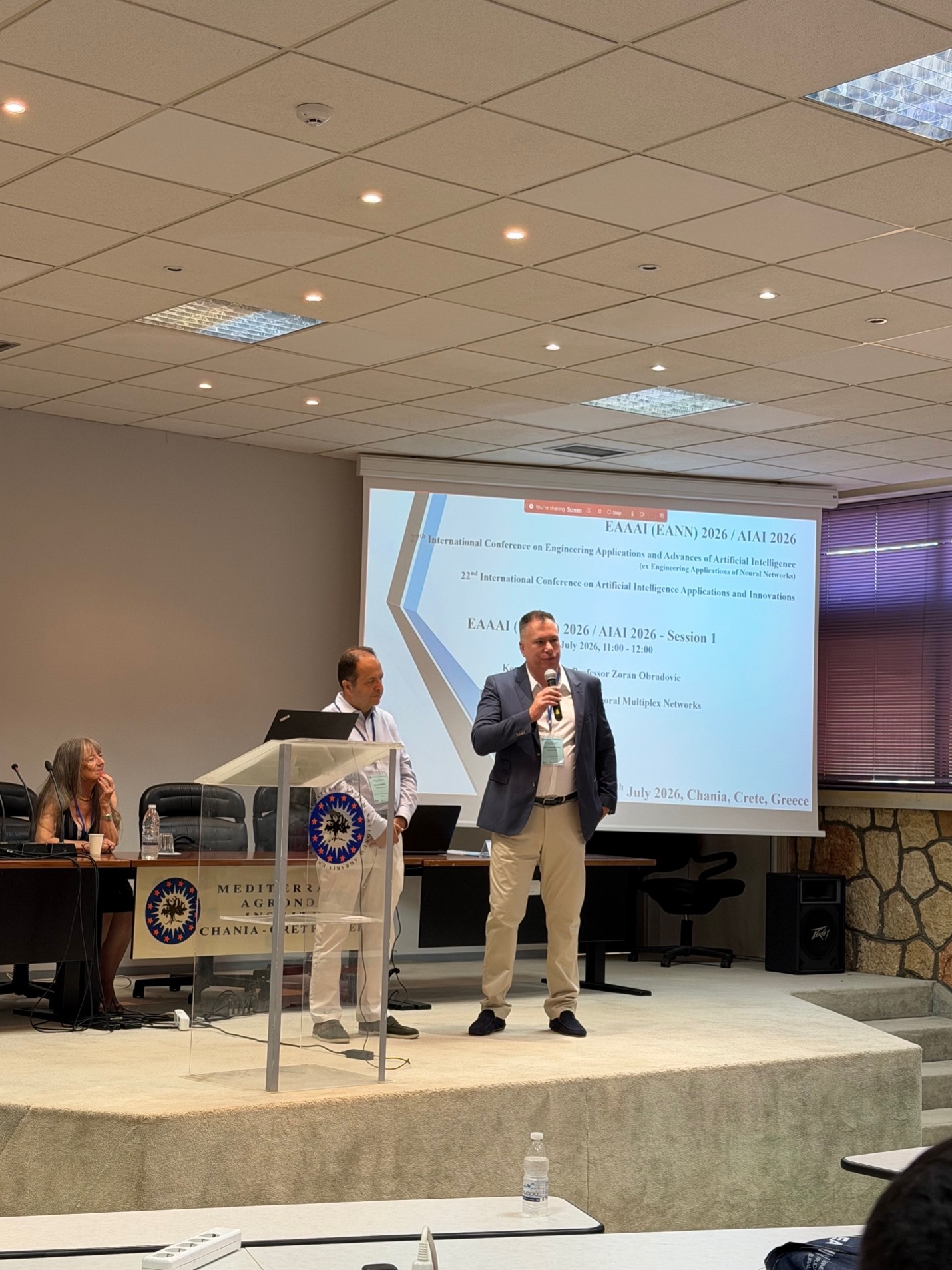
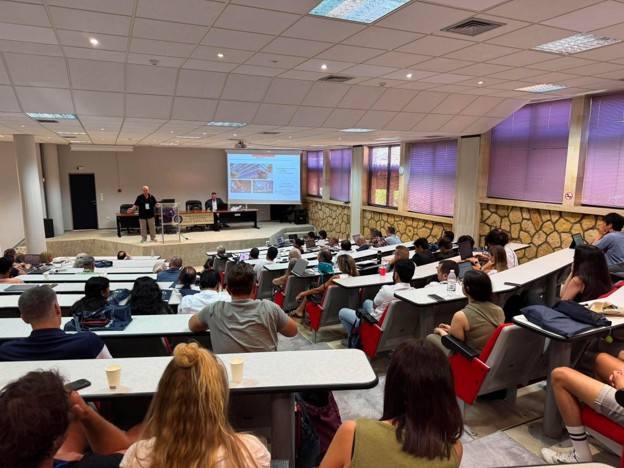
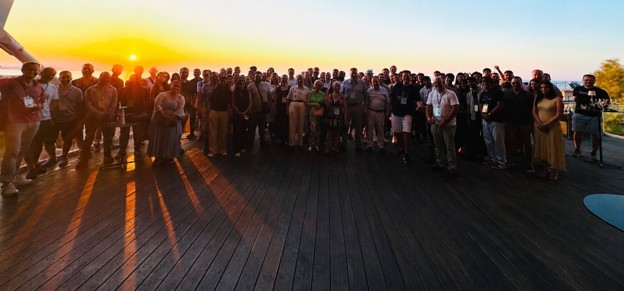
The 22nd International Conference on Artificial Intelligence Applications and Innovations—AIAI 2026—was successfully held from 16 to 19 July 2026 at the Mediterranean Agronomic Institute of Chania (MAICh), in Chania, Crete. Organised in a hybrid format, the conference welcomed researchers, academics, industry professionals and postgraduate students from across the world, providing an important international forum for presenting and discussing the latest developments in artificial intelligence.
AIAI is an annual conference of the International Federation for Information Processing and is organised under the auspices of IFIP Working Group 12.5 on Artificial Intelligence Applications. Since its establishment in 2004, the conference has developed into a mature and internationally recognised scientific event, connecting advances in AI methodology with innovative applications in science, industry and society.
The 2026 edition demonstrated the continuing growth and scientific impact of the conference. A total of 288 research papers were submitted, from which 122 full papers and five short papers were selected following a rigorous peer-review process. The accepted contributions were published by Springer in four volumes of the IFIP Advances in Information and Communication Technology series.
The official opening of AIAI 2026 was honoured by the presence of Professor Eunika Mercier-Laurent, Chair of IFIP Technical Committee 12 on Artificial Intelligence. Professor Mercier-Laurent addressed the conference’s welcome session together with the conference chairs, Professors Ilias Maglogiannis and Lazaros Iliadis, underlining the importance of international scientific collaboration and IFIP’s role in advancing responsible and human-centred artificial intelligence. She also chaired the plenary workshop of ethics in generative AI, which examined the ethical, professional and cybersecurity challenges arising from the rapidly expanding use of generative technologies.
A major highlight of the conference was its distinguished keynote programme, which featured four internationally recognized scholars. Professor Zoran Obradovic of Temple University presented “Modeling Interactions in Temporal Multiplex Networks,” discussing machine-learning approaches for analyzing complex interactions and events using heterogeneous and multimodal information. Professor Hojjat Adeli of The Ohio State University delivered the keynote “Impacts of AI on Humanity: Utopia versus Dystopia,” offering a broad reflection on the opportunities, risks and societal implications of artificial intelligence.
The third keynote, delivered by Professor Anastasios Tefas of Aristotle University of Thessaloniki, was entitled “AI for Trustworthy Autonomous Systems: From Reactive Machines to Reasoning Agents.” His presentation addressed the transition towards more intelligent, explainable and dependable autonomous systems. The final keynote was delivered by Professor Antonis Argyros of the University of Crete and the Foundation for Research and Technology–Hellas. Entitled “Seeing Humans Through AI: Advances in Human-Centered Computer Vision,” the lecture presented recent progress in modelling human pose, movement, gestures, activities and social interactions through advanced computer-vision methods.
The scientific programme reflected the remarkable breadth of contemporary artificial intelligence research. Topics included core machine-learning methods, optimisation and learning theory, natural-language processing, large language models, retrieval-augmented generation, agentic AI, automated reasoning, computer vision and multimodal perception. Dedicated sessions also addressed robotics and autonomous systems, medical imaging, biomedical decision support, health informatics, cybersecurity, privacy, trustworthy AI, industrial applications, sustainability, education, finance, recommender systems and semantic technologies.
Alongside the main technical sessions, AIAI 2026 included specialised workshops explored emerging and interdisciplinary areas including AI ethics, explainable AI in education, artificial intelligence for sustainable development, beyond-5G communications, digital health, technologies for older adults and AI-supported project management. These activities encouraged focused discussion, the exchange of research ideas and the development of new international collaborations.
The MAICh Conference Centre provided an inspiring setting for the event, combining modern scientific facilities with the natural and cultural environment of Crete. The conference’s social activities also gave delegates opportunities to experience Chania’s historic character and renowned hospitality while strengthening professional relationships beyond the formal sessions.
AIAI 2026 confirmed the conference’s position as an important meeting point for the international AI community. Through its high-quality scientific programme, interdisciplinary scope and strong emphasis on real-world applications, the event contributed meaningfully to the continuing development of artificial intelligence. It also highlighted the importance of international cooperation in ensuring that future AI technologies are innovative, trustworthy, human-centred and capable of addressing significant societal challenges.
Prof. Ilias Maglogiannis
Chair of IFIP TC12 WG 12.5 AI Application and General Co-Chair of AIAI 2026