
ΈρευναΥποβοηθούμενη διαβίωση & απομακρυσμένη φροντίδα
Φορετές Συσκευές και Παρακολούθηση
Φορετοί αισθητήρες και έξυπνες συσκευές που υποστηρίζουν την ανεξάρτητη διαβίωση με συνεχή και διακριτική παρακολούθηση.
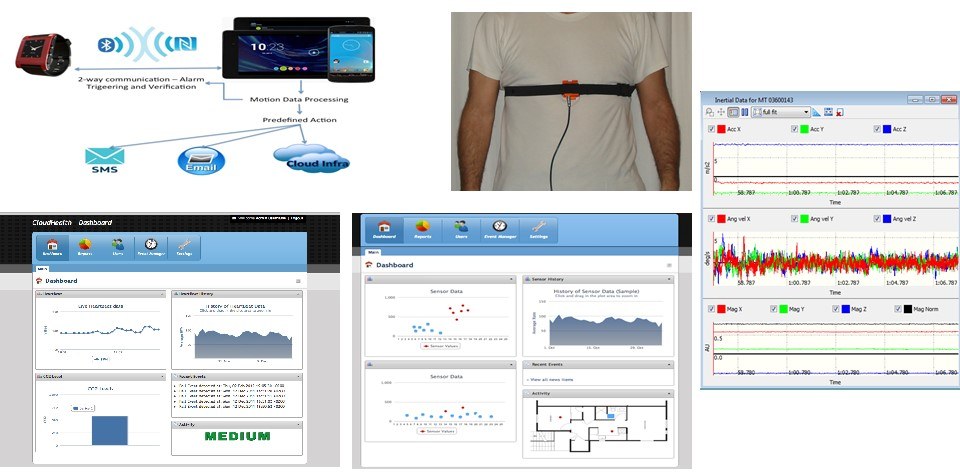
Οι φορετοί αισθητήρες, τα έξυπνα ρολόγια και τα κινητά τηλέφωνα μπορούν να παρακολουθούν συνεχώς και διακριτικά την κίνηση και τις ζωτικές ενδείξεις. Αναπτύσσουμε συστήματα υποβοηθούμενης διαβίωσης που μετατρέπουν αυτά τα σήματα σε ειδοποιήσεις, πίνακες παρακολούθησης και υπηρεσίες για ηλικιωμένους, ασθενείς και φροντιστές.
Οι πλατφόρμες μας επεξεργάζονται αδρανειακά και φυσιολογικά δεδομένα σε πραγματικό χρόνο, ενεργοποιούν προκαθορισμένες ενέργειες, όπως SMS, email ή ειδοποιήσεις στο νέφος, και ενσωματώνουν φορετές συσκευές IoT σε υπηρεσίες τηλεπαρακολούθησης. Πρόσφατες εργασίες επεκτείνουν αυτή την έρευνα στην ανάλυση βάδισης μετά από εγκεφαλικό επεισόδιο και στην παρακολούθηση του άγχους και της ευεξίας στην τριτοβάθμια εκπαίδευση.
- Αδρανειακή και φυσιολογική καταγραφή
- Ειδοποιήσεις και πίνακες τηλεπαρακολούθησης
- Ανάλυση βάδισης, άγχους και ευεξίας
Σχετικές δημοσιεύσεις
Επιλεγμένες εργασίες του εργαστηρίου σε αυτό το πεδίο.
A Recommendation System for Stress Management at the Workplace Using RAG-Based LLM
In Hybrid Human-AI Collaborative Networks. Springer Nature Switzerland, pp. 442–461.
A Multimodal Course Digital Twin for Adaptive Academic Planning: Integrating Physiological Stress, Self-Reports, and Academic Context
Computers, 15(6), p. 338.
A Lightweight Machine Learning Framework for Post-Stroke Gait Abnormality Classification Using Wearable Gyroscope Features
Sensors, 26(10), p. 3143.
Smart Insoles With Textile Capacitive Sensors for Efficient Gait Phase Recognition
IEEE Sensors Journal, 26(1), pp. 1255–1266.
Design and Implementation of a Platform for Managing Stress and Anxiety in Higher Education Based on Wearable Devices *
In 2025 20th International Workshop on Semantic and Social Media Adaptation and Personalization (SMAP). IEEE, pp. 55–58.
Students
Burnout Symptoms Detection Using Smartwatch Wearable Devices: A Systematic Literature Review’, AI Sensors, 1(1), p. 2.
Integrating IoT Wearable Devices in Telemonitoring Platforms for Continuous Assisted Living Services
In Healthcare Transformation with Informatics and Artificial Intelligence. IOS Press.
Quantifying Citizens
Well-Being in Areas with Natural Based Solutions Using Mobile Computing’, in Informatics and Technology in Clinical Care and Public Health. IOS Press.
Using mHealth Technologies to Promote Public Health and Well-Being in Urban Areas with Blue-Green Solutions
In Advances in Informatics, Management and Technology in Healthcare. IOS Press.
Designing a Cloud Based Platform for Monitoring Well-Being and Public Health in Areas with Natural Based Solutions
In Future Access Enablers for Ubiquitous and Intelligent Infrastructures. Springer International Publishing, pp. 95–102.
Pervasive Monitoring of Public Health and Well-Being in Urban Areas with Blue-Green Solutions
In Challenges of Trustable AI and Added-Value on Health. IOS Press.
Recommender systems for IoT enabled quantified-self applications
Evolving Systems, 11(2), pp. 291–304.
A low-cost IoT-based health monitoring platform enriched with social networking facilities
In 2018 IEEE International Conference on Pervasive Computing and Communications Workshops (PerCom Workshops). IEEE, pp. 173–178.
Advancing Quantified-Self Applications Utilizing Visual Data Analytics and the Internet of Things
In Artificial Intelligence Applications and Innovations. Springer International Publishing, pp. 263–274.
Recommender Systems for IoT Enabled m-Health Applications
In Artificial Intelligence Applications and Innovations. Springer International Publishing, pp. 227–237.
On the Integration of Wearable Sensors in IoT Enabled mHealth and Quantified-self Applications
In Interactive Mobile Communication Technologies and Learning. Springer International Publishing, pp. 77–88.
A Versatile Architecture for Building IoT Quantified-Self Applications
In 2017 IEEE 30th International Symposium on Computer-Based Medical Systems (CBMS). IEEE, pp. 500–505.
Human centered computing for the development of assistive environments
In Proceedings of the 7th International Conference on PErvasive Technologies Related to Assistive Environments. ACM, pp. 1–7.
An Overview of Affective Computing from the Physiology and Biomedical Perspective: An Overview of Affective Computing from the Physiology and Biomedical Perspective
In Semantic Multimedia Analysis and Processing. CRC Press, pp. 367–395.
Channel Models for On-Body Communications
In Wearable Sensors. Elsevier, pp. 453–473.
Assistive environments for the disabled and the senior citizens: theme issue of PETRA 2010 and 2011 conferences
Personal and Ubiquitous Computing, 18(1), pp. 1–3.
Pervasive technologies and assistive environments: cognitive systems for assistive environments: special issue of PETRA 2010 and 2011 conferences
Universal Access in the Information Society, 13(1), pp. 1–4.
Cognitive and context-aware assistive environments using future internet technologies
Universal Access in the Information Society, 13(1), pp. 59–72.
Bringing IoT and Cloud Computing towards Pervasive Healthcare
In 2012 Sixth International Conference on Innovative Mobile and Internet Services in Ubiquitous Computing. IEEE, pp. 922–926.
Managing Wearable Sensor Data through Cloud Computing
In 2011 IEEE Third International Conference on Cloud Computing Technology and Science. IEEE, pp. 440–445.
Context-aware delivery of information in assistive environments utilizing future internet technologies
In Proceedings of the 4th International Conference on PErvasive Technologies Related to Assistive Environments. ACM, pp. 1–6.
Pervasive technologies and assistive environments: social impact, financial, government and privacy issues
Universal Access in the Information Society, 10(2), pp. 111–114.
Digital cities of the future: Extending @home assistive technologies for the elderly and the disabled
Telematics and Informatics, 28(3), pp. 176–190.
An overview of body sensor networks in enabling pervasive healthcare and assistive environments
In Proceedings of the 3rd International Conference on PErvasive Technologies Related to Assistive Environments. ACM, pp. 1–10.
Optimizing pervasive sensor data acquisition utilizing missing values substitution
In Proceedings of the 3rd International Conference on PErvasive Technologies Related to Assistive Environments. ACM, pp. 1–8.
Adoption of Wearable Systems in Modern Patient Telemonitoring Systems
In Handbook of Research on Developments in E-Health and Telemedicine. IGI Global, pp. 1004–1023.
Advanced Sound and Distress Speech Expression Classification for Human Status Awareness in Assistive Environments
Journal on Information Technology in Healthcare, 7(2), pp. 111–117.
An Overview of Tools and Technologies for Anxiety and Depression Management Using AI
Applied Sciences, 14(19), p. 9068.
Fatigue and Burnout Management in Nursing Staff Using Wearable Data
In 2026 IEEE 39th International Symposium on Computer-Based Medical Systems (CBMS). IEEE, pp. 348–353.
Autoregressive energy-efficient context forwarding in wireless sensor networks for pervasive healthcare systems
Personal and Ubiquitous Computing, 18(1), pp. 101–114.
Short-Horizon Prediction of Player Well-Being from Gameplay Behavior and Psychological Signals
In Health Sciences Informatics Leads and Empowers the Digital Health Transformation. IOS Press.